Basic Theory of TCM
Theory of “Yin” and “Yang”
The theory of Yin-Yang originated in antiquity in China. It is a theory dealing with the originated of the universe as well as the motion and variation of all things in the natural world. It holds that the natural world is made up of material and that the material world conceives, develops and constantly varies under the interaction of Yin and Yang. Therefore, everything in the universal can be divided into the aspects of Yin and Yang, such as the heaven and the earth, the day and the night, the water and the fire, upper and lower, cold and heat as well as man and women etc. Any aspect of Yin and Yang in an object can be further and infinitely divided. For an example, Daytime pertains to Yang while night to Yin. However Daytime can be further divided into two phase: morning pertains to Yang while afternoon to Yin
Application of the theory of Yin-Yang in TCM
- Explanation of the histological structure of the human body
- Explanation of the relationship between structure and function
- Explanation of pathogenesis
- Diagnosis and syndrome differentiation
- Guiding clinical treatment
Theory of five elements
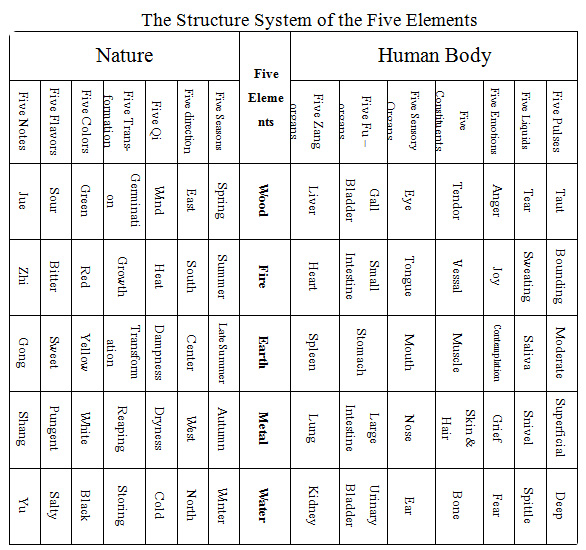
Five elements refers to the movement and transformation of the five categories of things in the natural world, there are wood, fire, earth, metal and water. The theory of five elements holds that all things on the natural world are derived from wood, fire, earth, metal and water. So they all bear the basic properties of these five elements and maintain a harmonious balance through the activities of constant inter-promotion and inter-restraint among the five elements. The relationship among the five elements can be illustrated in the following table:
The Structure System of the Five Elements
Application of the theory of the five elements:
- Explaining the physiological function of the five zang-organs elements and the relationship among them.
- Explaining interactions among the five zang-organs.
- Guiding clinical diagnosis
- Guiding the treatment of diseases
The Theory of Zang Xiang (Viscera and their Manifestations)
The content of Zangxiang theory is composed of three parts: the physiological functions and pathological changes of the viscera, the description of which mainly focuses on the physiological functions; the relationship between the five-zang organs and the body, organs and orifices, example the relationship between the five-zang and the five constituents; the relationship between the zang organs and the fu organs, including the relationship among the five zang organs, among the six fu organs and the relationship between the zang organs and the fu organs.
Though all pertain to the internal organs, the five zang organs and the six fu organs are difference from each other in functions and characteristics. The common function of the five zang organs is refined food nutrient responsible for maintenance of life activities. However the common function of the six fu organs is to receive and digest food, absorbing the nutrients and discharging the waste. That is why TCM has divided the internal organs into two distinct categories.
Zang-fu is the core of life activities. The Zangxiang theory holds that the substantial bases responsible for the physiological functions of the five zang-organs and the six fu organs come from two aspects:
- Morphological structure in anatomy. Difference morphological structure in bears certain internal relationship with the physiological functions of certain internal organs. Take the heart as an example, since the heart is directly connected with the vessels, it bears the function of propelling blood to flow in the vessels.
- The refined nutrient like Qi, blood, yin and yang. Zang xiang theory holds that qi, blood, yin and yang are the essential substances for constituting and maintaining the physiological functions of the organs. Substantially, these refined substances are fine and minute. Though invisible to the eyes, they can still be understood and distinguished according to their physiological functions and pathological changes.
Basically, Zang xiang theory focuses on the study of physiological functions and pathological changes of the zang fu organs, somatic tissues and organs as well as the mutual relationship among them. Though terminological identical with some of the organs in modern medicine, the zang-fu organs in zangxiang theory are quite difference in physiological functions. The functions of these organs in TCM are extensive, not only including the functions of the organ in modern medicine, but also covering certain functions of other related organs. Obviously the zang-fu organs in TCM are not just the conceptions of anatomy, but synthetic functional units.
The Theory of Qi, Blood and Body Fluid
Qi, blood and body fluid, the essential substances for life activities, flow constantly inside the body and all originate from the viscera. They are produced by qi-transforming activities of the viscera and infused into the viscera to nourish the organs and tissues of the body.
Among the three, qi is the most active but invisible substance; blood and body fluid are visible, but must depend on the propelling action of qi to circulate in the whole body.
The Concept of Qi
The classic Chinese philosophy believes that the primary state if the universal is qi, the constant movement of which produces all the things in the universe, including life. TCM holds that the accumulation of qi would produce life while the dispersion of qi means the end of life. Hence, all substances in the body and the life activities are depending on the constant motion and change of qi.
The characteristics of qi are:
- Very active and in constant motion
- Qi is also extremely fine and invisible.
The physiological functions of Qi
- Propelling function. The motivation of all the viscera and organs in the body.
- Warming function. The source of heat energy in the body.
- Protecting function. Protect the body, resisting the invasion of various pathogenic factors and preventing disease.
- Fixating function. Astringe and control all the liquid substances, such as blood and body fluid and prevent from losing.
- Qi-transforming function. The essential cause of the conception, development, growth and decline of life.
The Basic concept of blood
Blood, mainly composed of the qi (nutrient) and body fluid, circulates inside the vessels. Blood functions to nourish and moisten the body. It is vital to the maintenance of life.
The physiological functions of blood
- Nourish and moisten the body. Blood transport nutrient substances to all parts of the body, maintained the functions of the organs. Blood is also the importance material base for mental activities, if blood is sufficient, there will be sufficient vitality; otherwise there will be tired.
- Transport the waste. Blood transport the body wasted to lung, kidney and superficies and excreted though respiration, urination and sweating.
The basic concept of body fluid
Body fluid is a basic substance that makes up the body and maintains life activities. The main component of body fluid is water, also including nutrient substance. When the body fluid in the vessels, it is a component of blood; however, it also flows outside the vessels and between / in the viscera and the body. If body fluid secreting or excreting from the sensory organs or the nine orifices, it becomes urine, sweating, tears, snivel and saliva etc.
The physiological functions of body fluid
- Moistening and nourishing
- The transformation of blood
- The transportation of the wasted
The relationship among qi, blood, and body fluid
The relationship between qi and blood, body fluid
- The effect of qi on blood, body fluid
- Qi producing blood, body fluid
- Qi promoting the circulation of blood, body fluid
- Qi controlling the blood, body fluid
- The effect of blood, body fluid on qi
- Blood, body fluid carry qi
- Blood, body fluid producing qi
The Theory of the meridians and collaterals
The meridians are the main trunks in the system of the meridians and collaterals while the collaterals are the branches of the meridians. The collaterals stem from the meridians and fork into difference levels of smaller and finders ones. The main function of the meridians and collaterals is to transport qi and blood, connect the viscera with other organs and combine the body into an organic whole.
The content of the theory of meridians and collaterals
The meridians and collaterals system is divided by meridians system and collaterals system, including:
- The twelve meridians
- The lung meridian of hand Tai-yin
- The large intestine meridian of hand Yang-ming
- The stomach meridian of foot Yang-ming
- The spleen meridian of foot Tai-yin
- The heart meridian of hand Shao-yin
- The small intestine meridian of hand Tai-yang
- The bladder meridian of foot Tai-yang
- The kidney meridian of foot Shao-yin
- The pericardium meridian of hand Jue-yin
- The triple energizer meridian of hand Shao-yang
- The gall-bladder meridian of foot Shao-yang
- The liver meridian of foot Jue-yin
- The extraordinary meridians
- The twelve branches of the meridians
- The twelve tendons
- The twelve skin divisions
- The fifteen divergent collaterals
- The floating collaterals
- The minute collaterals
- The eight collaterals
- The thoroughfare collateral
- The conception collateral
- The governor collateral
- The belt collateral
- The yang link collateral
- The yin link collateral
- The yang heel collateral
- The yin heel collateral
The basic functions of the meridians and collaterals
- To connect the external with the internal as well as to connect the viscera with other organs
- To transport qi, blood, yin and yang to nourish the viscera and the body
The clinical application of the theory of meridians and collaterals
- To explain pathogenesis and pathological transmission
- To guide the diagnosis and treatment of disease.
|